
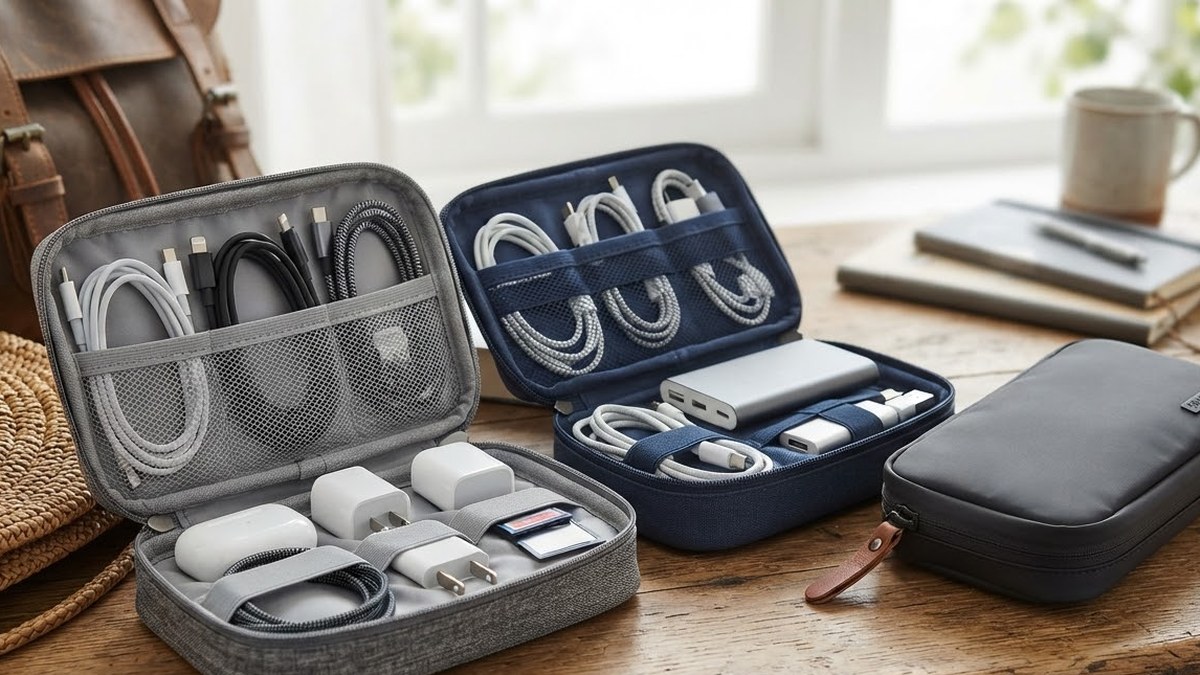
Everyone has opened a bag to find the earbuds knotted around a charging brick and a cable bent hard against the zip. It is rarely the cable that fails first; it is the joint where the cable meets the plug, and that joint gives out because the cord spent a week folded at an angle in a side pocket. A cable organizer case stops that by giving every cord a loop of its own.
The cases below split into three jobs, and it is worth knowing which one you actually need before you buy.
| Shape | Holds | Best for |
|---|---|---|
| Hard-shell organizer | Laptop brick, mouse, several cables, power bank | Working away from home |
| Flat zip case with elastic loops | Cables, adapters, SD cards | Keeping a bag tidy day to day |
| Small pouch | One set of earbuds plus a cable | Pocket or handbag |
Buying the wrong shape is the usual mistake. A hard shell built for a laptop brick is dead weight in a handbag, and a soft pouch does nothing to stop a power bank crushing whatever sits beside it in a rucksack. Work out what you carry on an ordinary day rather than what you carry on the worst day, because the case you buy for one trip a year is the one you stop packing by March.
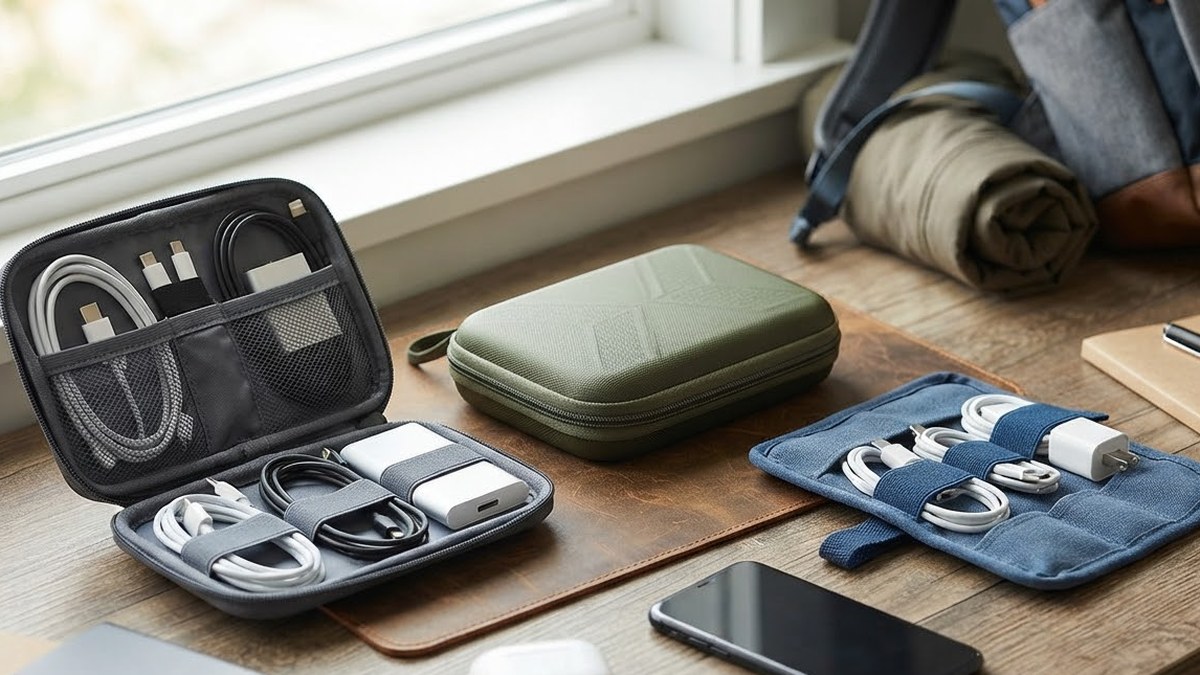
These run from a full workstation kit down to something that lives in a coat pocket, all from the same electronics organizer bag category.
The largest of the six and the one to pick if you carry a laptop charger. It takes the brick, a mouse, a power bank and a run of cables in separate elastic loops, so nothing presses against anything else. This is the case that replaces a carrier bag of tangled gear.
Two cases rather than one, which solves a problem most people work around badly: keeping work gear and personal gear apart. Comes with cable ties, so the longer cords are coiled before they go in rather than stuffed.
Eight named loops and a flat profile. It slides down the back of a laptop sleeve without adding bulk, and because every cable has an assigned loop you can tell at a glance what you forgot before you leave.
Multi-pocket rather than loop-based, which suits anyone carrying odd shapes: adapters, dongles, a spare mouse. Pockets are more forgiving than loops when the items are not all cable-shaped.
A zip case sized for one set of earbuds and a charging cable. It is the thing you keep in a jacket rather than a bag, and it stops the earbuds from ending up loose at the bottom of a pocket with your keys. Small enough that carrying it costs you nothing, which is the only reason a case like this actually gets used.
Two layers that fold against each other, so the heavy items sit on one side and the fragile ones on the other. Useful if you carry a power bank, which is the item most likely to damage whatever it shares a pocket with.
Coil cables over and under rather than round and round. A cable wound in one direction builds a twist that eventually kinks, which is why the one you have owned longest is the one that fails.
Keep the case packed even at home. The point of an organizer is that the charger is always in it; a case you empty onto the desk each evening is just another pouch.
Replace the ties, not the case. The elastic loops outlast the cables they hold, and a case with one stretched loop is still doing its job everywhere else.
And give the short cables their own home. A charger and cable pouch only saves time if the one-metre lead you use daily has a fixed loop, rather than being pushed into whichever gap is free.
Match the case to what you actually carry. Laptop brick means a hard-shell organizer, a day bag means a flat loop case, and earbuds alone mean a pouch. All six are listed on Temu, so you can compare the loop layouts before committing to one.
Bookmark OrganizeTrip if you carry a bag full of gear, because the accessory coverage there grows as new kit lands.